The panel will also recommend a fiscal consolidation road map for the central and state governments, study the impact of GST on the divisible pool, and propose performance-based incentives for states.

If he expects the states to take steps for controlling inflation, he should also respect the country's federal structure and not assume a veto power at the GST Council.

In the four-paragraph letter, Jaitley said he had orally informed Modi about his desire not to be a part of the new BJP government to enable him to concentrate on treatment and health.
While presenting her 2021-22 Union Budget, Finance Minister Nirmala Sitharaman had set a fiscal deficit target of 6.8 per cent of nominal gross domestic product (GDP) against the 2020-21 Revised Estimate of 9.5 per cent. The fiscal correction in the upcoming 2022-23 Union Budget is unlikely to be that steep. Even as discussions among top Budget-makers are ongoing, the fiscal deficit target for 2022-23 may likely be in the range of 6.5-6.8 per cent.

The FM has been making efforts to make the taxation laws simpler.

The Planning Commission was better than the Niti Aayog as it used to take up the issues of the states with the ministries concerned.

Finance Minister P Chidambaram on Tuesday said the country must have a basic tax structure that is broad-based and oriented to low tax rates.

'We forecast real GDP growth to moderate to 6.7 per cent in the year ending March 2018.' 'However, as disruption fades, we expect to see a rebound in real GDP growth to 7.5 per cent in the next fiscal year.'

'The finance ministry and the RBI will never admit to the difficulties in the economy because if they do so, it will adversely impact the financial markets, etc.' 'They like to present a rosy picture that everything is fine and under control.'

'Under this government, tax laws have become more draconian, and the government itself is setting stiff, unrealistic targets for tax officials, who have got more powers to harass us,' points out Debashis Basu.

The remarks came amid reports of mounting tension between the finance ministry and the RBI over the autonomy of monetary policy makers.
Jaitley said inflation has been under control for long and is likely to remain so on the back of good monsoon and unlikely spike in oil prices.

General Budget is a terminology earlier used to differentiate between the Union Budget with the Railway Budget. Full-fledged budgets are titled "Union Budget", while interim Budgets are titled just that.
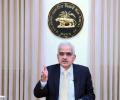
The challenge for the RBI in 2024 is likely to be less about containing elevated inflation and more about curbing excessive financial market exuberance and a 'problem of plenty', notes Sajjid Chinoy, Chief India Economist JP Morgan.
Stating that he had consistently held Singh in high respect, he expected the same from him.
Expressing the government's commitment to continue with reforms, Finance Minister Nirmala Sitharaman on Thursday assured India Inc that it is ready to do everything required to revive and support economic growth hit by the COVID-19 pandemic. Stressing that there is a need to promote growth as it helps bring down poverty, she however said it would not be at the cost of inflation. RBI has been mandated to keep inflation at 4 per cent, with tolerance level of 2 per cent on either side.
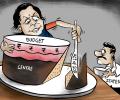
Every option before the finance minister comes with a price tag, observes T N Ninan.

Jaitley said the government has created transparent environment.

The surge in export, domestic demand and public spending in infrastructure projects might revive private investment during 2017-18.

The Finance Minister impressed upon the need to attract more investments for the manufacturing sector.
'Whoever whispered in his ears that go for demonetisation, misled him completely' and the PM lacked the sagacity to know that it would not work, Yashwant Sinha tells Archis Mohan.

Stating that India's consolidated deficit is the highest among the G20 nations, Gopinath added it is important for India to undertake reforms.
The Congress leader also targeted Modi over "hasty" implementation of the GST, and his pet bullet train project.

A K Bhattacharya lists three reasons why Finance Minister Arun Jaitley will most likely present a full Budget on February 1, 2019.

Minister of State for Commerce and Finance Nirmala Sitaraman, in Mumbai to address election rallies, took time out to talk about the economy, foreign investment and trade facilitation.
Common return for excise duty and service tax was envisaged when 119 services were taxed.
Finance ministry tells PM fiscal deficit target will be met, capex expenditure won't be cut and GDP growth will surpass 7.5%.
Subramanian was the Dennis Weatherstone Senior Fellow at the Peterson Institute for International Economics and Senior Fellow at the Centre for Global Development in the US before joining the ministry.

Never before has the need for creating an ambience for economic policy reforms been as critical as it is now, points out A K Bhattacharya.
'It is entering growth territory on a month-on-month basis.'

Ahead of India's annual budget presentation next week, IMF's chief economist Gita Gopinath has favoured the extension of the pandemic support measures, thrust on investment in infrastructure and expanding health sectors programmes like Ayushman Bharat, and a very credible divestment path for commercially viable companies. The Indian government has provided a lot of schemes for small and medium enterprises, most of which is in the form of liquidity support, Gopinath told PTI on Tuesday. "And you want to revisit it and see how effectively that is working and see whether additional support may need to be provided," she said while responding to a question on her recommendations to Finance Minister Nirmala Sitharaman, ahead of her presentation of the annual Union Budget on February 1. It would be a good time for banks and Non-Banking Financial Companies (NBFCs) to raise capital given the attractiveness of financing conditions at this point, she said.

As soon as the House met at 2 pm, papers were laid on the table and two resolutions adopted amid slogan shouting and protest by Congress members.
'The Budget numbers presented severely underestimate the magnitude of the unstated fiscal crisis that we went through in 2018-2019, which cannot be conceivably be fully reversed in 2019-2020,' points out Rathin Roy, director, National Institute of Public Finance and Policy.
Last month, Prime Minister Narendra Modi had said that the economy is showing "green shoots" as the country emerges from the coronavirus lockdown and underscored the importance of being focussed on both life and livelihood.

'The Modi government is trying hard to see if it could be sold to a private airline.' 'But it appears there are no takers.' 'If no buyer comes forward by June, the government will close down Air India,' predicts A K Bhattacharya.

'Most of the measures the finance minister announced will take effect after the lockdown.' 'By that time, millions of people will be starving.'
However, independent economists are not as gung-ho as the finance ministry over the likelihood of deficit target being met this time around, says Indivjal Dhasmana.
The immediate revenue loss could worsen the Centre's fiscal deficit, from the budgeted 3.3 per cent of gross domestic product (GDP) to 3.7 per cent of GDP -- a massive 40-basis-point increase. It was stabilised at 3.4 per cent since 2016-17, report Abhishek Waghmare and Dilasha Seth.

The passing of the GST bill and the failure of India to acquire NSG membership is set to rule the agenda in Parliament.
'There is a time for lowering one's expectations of the economy -- and therefore not trying to do too much in the Budget,' notes T N Ninan.
